Skip to content

FCL, LCL and groupage

Home  —  FCL, LCL and groupage

Whether to buy a whole container or a share of one — and the four ways that can be arranged.

The booking

A container, or a corner of one

Ocean freight is sold two ways. Take the whole box and it is sealed at your premises and opened at the consignee’s: nobody handles the cargo in between. Take a share and your pallets travel with other people’s, which is cheaper for a small consignment and costs you handling and time at both ends.

Those two can also be mixed. A single shipper sending to several consignees, or several shippers sending to one, each has an arrangement of its own — and picking the right one is usually worth more than haggling over the rate.
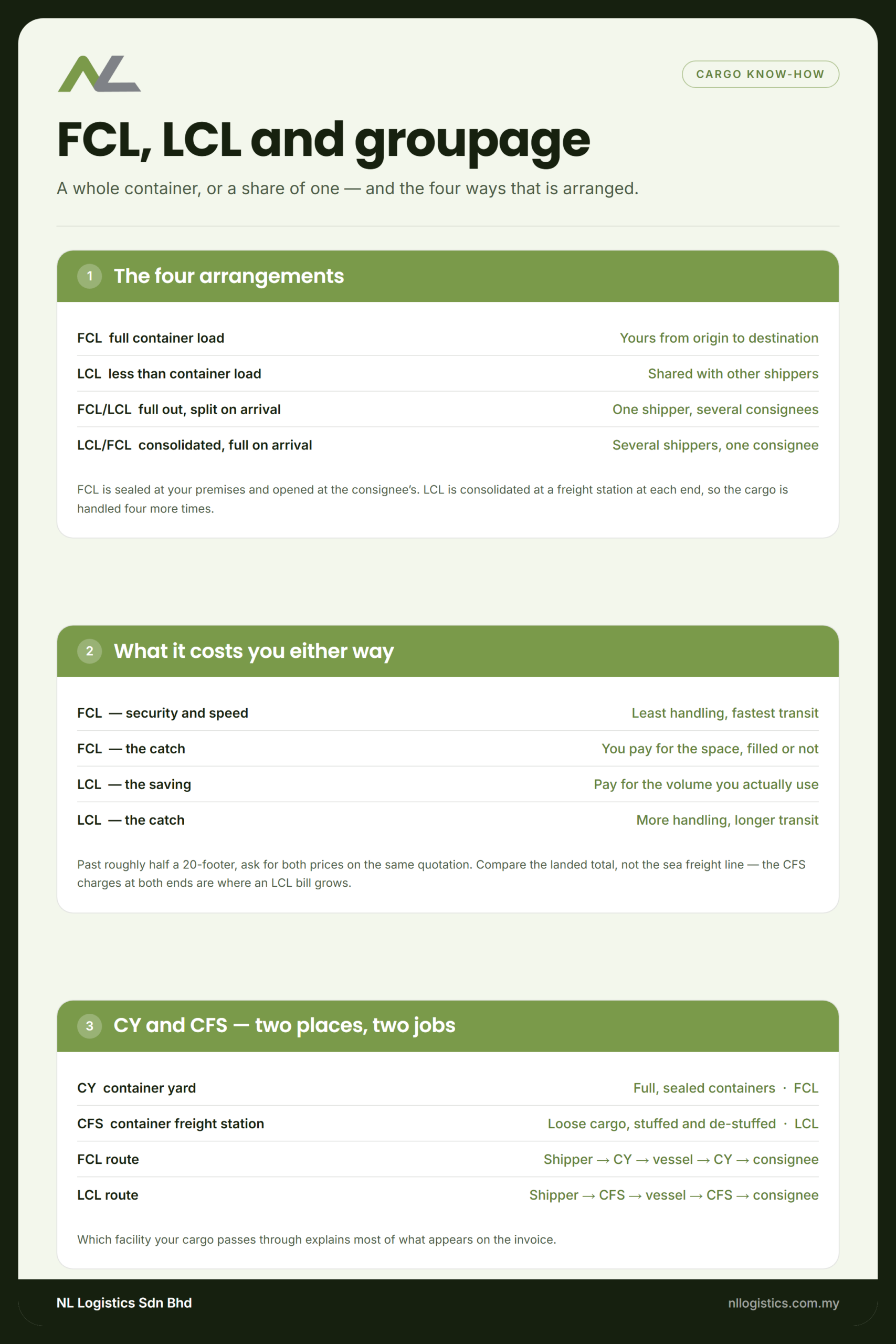

The four arrangements

How the container is bought

at each end

The first two are the common ones. The mixed pair exist because cargo rarely has one sender and one receiver.

FCL

Full container load

What it is

The whole container is yours, origin to destination.

Handling

Sealed at your location, opened at the consignee’s.

Moves

Container yard to container yard.

Trade-off

Secure, faster, least handling — you pay for the space whether you fill it or not.

Best for

Large shipments that can fill a container.

LCL

Less than container load

What it is

Your cargo shares a container with other shippers’.

Handling

Consolidated at a CFS at origin, deconsolidated at one at destination.

Moves

Shipper → CFS → container → CFS → consignee.

Trade-off

Cost effective and flexible — more handling and a longer transit.

Best for

Small shipments that do not need a full container.

FCL/LCL

Full at origin, split at destination

What it is

Sent as a full container, broken down on arrival.

Handling

Sealed at origin; deconsolidated at the destination CFS.

Moves

One shipper out, several consignees in.

Trade-off

FCL safety on the water, distribution at the far end.

Best for

One shipper with several consignees at destination.

LCL/FCL

Consolidated at origin, full at destination

What it is

Several shippers’ cargo consolidated into one container for one receiver.

Handling

Consolidated at the origin CFS; discharged as a full container.

Moves

Several shippers out, one consignee in.

Trade-off

Cost efficient at origin, full-container delivery at destination.

Best for

Multiple suppliers feeding one large receiver.

The journey

What happens to the box,

step by step

The difference between the two is not the vessel. It is how many times the cargo is touched.

FCL — five stops

01

Pick up

Cargo is loaded into the container at the shipper’s premises.

02

Loading

The full container is loaded at the origin port.

03

Ocean transport

Sealed, and shipped to the destination port.

04

Discharge

The full container is discharged, still sealed.

05

Delivery

Delivered to the consignee’s location and opened there.

LCL — six stops, and two of them are shared with other people’s cargo

01

Pick up

Cargo collected from the shipper.

02

CFS, origin

Checked, sorted and consolidated with other shipments.

03

Loading

One container is stuffed with several shippers’ cargo.

04

Ocean transport

Shipped to the destination port.

05

CFS, destination

De-stuffed and deconsolidated into separate shipments.

06

Delivery

Each consignee receives their own cargo.

Where it happens

CY and CFS are not the same place

Two facilities, two jobs. Knowing which one your cargo goes through explains most of what appears on the invoice.

CY — container yard

A port or terminal area where full containers are received, stored and handled before and after vessel operations. The container stays sealed and intact. Container-level handling.

CFS — container freight station

A facility where cargo is consolidated, stuffed, de-stuffed and deconsolidated, mainly for LCL. Individual shipments are handled here. Cargo-level handling.

FCL moves CY to CY

Nobody opens the box between your loading bay and the consignee’s. Fewer hands, fewer chances of damage or a miscount.

LCL passes through both CFSs

Shipper to CFS, into a shared container, out at a CFS at the far end, then on to the consignee. Every one of those is a handling charge.

Why LCL takes longer

A shared container waits for enough cargo to fill it, and the deconsolidation queue at destination is not yours to control.

Why the LCL rate is not the whole cost

Origin and destination CFS charges, documentation and handling are quoted separately. Compare the landed total, not the sea freight.

Before you book

The crossover point moves

When LCL stops being the cheaper answer

Past roughly half a 20-footer, price both and compare

Where the two meet depends on the lane, the season and what the CFS charges at each end — there is no fixed cubic metre at which LCL becomes FCL. Once a consignment is large enough to be a real question, ask for both on the same quotation and compare the landed figure, not the sea freight line.

FCL, LCL and groupage — the one-page version

The whole guide on a single sheet, sized for WhatsApp and for A4. Ours to give away.

Where this applies

The lines this touches

Where the arrangement is chosen and the space is booked.

Consolidation and deconsolidation, and the storage either side of it.

Clearance, which differs for a shared container and a sealed one.

Want both an FCL and an LCL price on the same cargo?