Skip to content

Shipping abbreviations

Home  —  Shipping abbreviations

The short forms that fill a quotation, a booking confirmation and a bill of lading.

The vocabulary

A quotation is mostly initials

Freight paperwork is written in abbreviations, and nobody explains them because everyone in the trade already knows. That is fine until you are the one holding the quotation and trying to work out whether THC is included and what O/F stands for.

This is the working set — the ones that actually appear on Malaysian export and import documents. Grouped by where you will meet them rather than alphabetically, because that is how you will need to look them up.

On the booking

How the cargo is sold,

and where it sails from

These decide the shape of the shipment before anything is loaded.

Load and route

What you are buying

FCL

Full container load — the whole box is yours.

LCL

Less than container load — part of a container, shared.

POL

Port of loading — where it sails from.

POD

Port of discharge, or destination — where it lands.

SSL

Shipping line — the carrier operating the vessel.

R/O

Routing order — instructions on how the cargo is to be routed.

Best for

The first five lines of almost every booking confirmation.

Cargo and measure

What is being moved

COMM

Commodity — what the goods actually are.

DIM

Dimensions — length, width and height as packed.

VOL

Volume.

CBM

Cubic metre (m³) — the unit sea freight is priced against.

FT

Feet — as in a 20-foot or 40-foot box.

Best for

The figures your rate is calculated from. See the CBM guide for the arithmetic.

On the equipment and the charges

The box,

and what it costs to handle

Container types are usually written as a size plus one of these codes — 40HC, 20DC.

Equipment

The box itself

CNTR

Container.

DC

Dry container — a standard general-purpose box.

HC

High cube — the taller version, 2.90 m external.

Best for

Combined with a size: 20DC, 40HC. See the container guide for dimensions.

Charges and time

What appears on the invoice

O/F

Ocean freight — the sea leg itself.

A/F

Air freight.

THC

Terminal handling charges — the terminal’s own fee, at each end.

FUL

Fuel — the fuel surcharge element.

SEC

Security — the security surcharge.

F.T

Free time — the days before demurrage or detention starts.

T.T

Transit time — how long the journey takes.

Best for

THC, FUL and SEC are the three most often left out of a headline rate.

On the documents

Which piece of paper

you are being sent

Ocean shipments get bills of lading; air shipments get airway bills. Each comes in a master and a house version.

Sea documents

Bills of lading

B/L

Bill of lading — receipt, contract of carriage, and sometimes title.

MBL

Master bill of lading — issued by the shipping line to the forwarder.

HBL

House bill of lading — issued by the forwarder to the shipper.

Best for

The HBL is the one an exporter usually holds. See the bill of lading guide.

Air documents

Airway bills

MAWB

Master airway bill — issued by the airline to the forwarder.

HAWB

House airway bill — issued by the forwarder to the shipper.

Best for

The same master-and-house structure as sea, different paper.

On the contract

Who bears

what, and how far

These come from the sales contract rather than the transport booking, and everything else follows from them.

Trade terms

Agreed before the freight is booked

INCOTERMS

International Commercial Terms — the ICC rules dividing cost and risk between seller and buyer.

T.O.S

Term of shipping — the agreed Incoterm for that shipment.

FOB

Free on board — one of the most-used Incoterms; the buyer takes over once the goods are on board.

Best for

Get these agreed first. The freight term on the bill has to match them.

Before you book

Two of these look identical and are not

FT and F.T

FT is feet. F.T is free time.

A 40 FT box and 5 F.T days are two entirely different things, written almost the same way, and both appear on the same booking confirmation. Read them in context: a number in front means feet, a number of days after means free time. If a document is ambiguous, ask — it is the difference between the size of the container and how long you have to collect it.

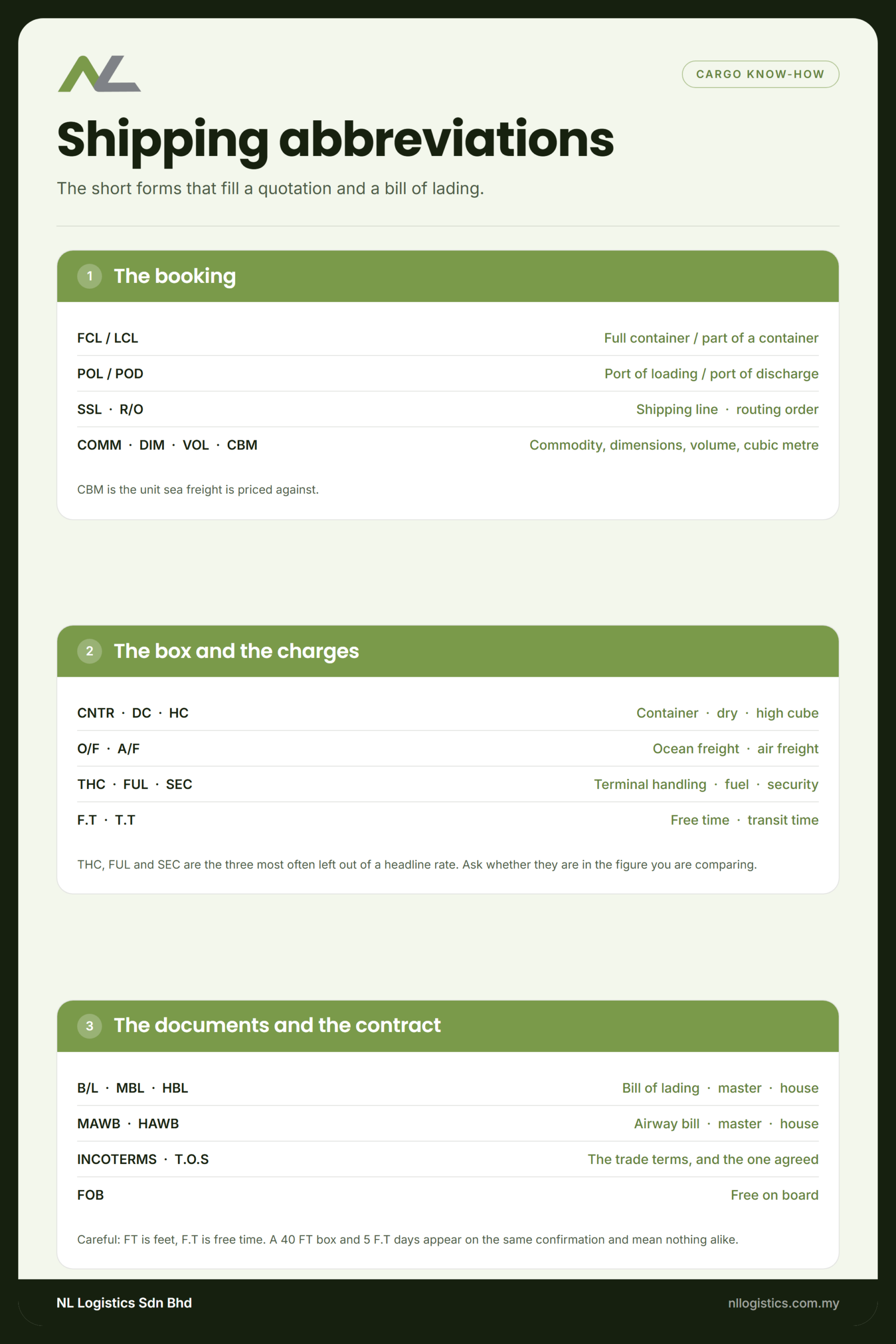
Shipping abbreviations — the one-page version

The whole guide on a single sheet, sized for WhatsApp and for A4. Ours to give away.

Where this applies

The lines this touches

Where most of this vocabulary is generated.

Where the document codes have to match the declaration.

Where the carrier’s own terms and surcharges come from.

Got a quotation with a line on it you cannot place?