Skip to content

Freight prepaid or collect

Home  —  Freight prepaid or collect

Who pays the carrier, where they pay it, and why the two words on the bill of lading matter.

The terms

Two words that decide who is out of pocket

Every bill of lading says either freight prepaid or freight collect. It is a small field on the document and it settles a large question: whether the seller pays the carrier at origin, or the buyer pays at destination.

Get it wrong and the cargo lands with an unexpected invoice attached to it, in a country where neither party wants to argue about it. The term must agree with what the sales contract already said — which is why this belongs beside the Incoterm, not after it.

The two terms

Who pays,

and who therefore decides

Whoever pays the carrier is normally the one who books it. Payment and control travel together.

Freight prepaid

Paid by the shipper / exporter

Paid

At origin.

Paid by

The seller.

Who controls transport

The seller — they choose the carrier and the routing.

On the documents

Marked “Freight Prepaid”.

Best for

Seller-managed shipments, and anywhere the seller wants control of the routing.

Freight collect

Paid by the consignee / importer

Paid

At destination.

Paid by

The buyer.

Who controls transport

The buyer — their carrier, their contract, their rates.

On the documents

Marked “Freight Collect”.

Best for

Buyer-managed shipments, and buyers with freight rates better than their supplier’s.

Why it is worth getting right

Four things the term quietly decides

None of these are about the freight rate itself. They are about who is exposed when something moves.

Accurate documentation

The freight term appears on the bill of lading and the invoice. If those two disagree, the bank and the customs broker both stop.

Cost responsibility

A clear understanding of who pays, agreed before the booking rather than argued after arrival.

Smooth operations

Avoids the delays, disputes and extra charges that come from cargo landing with an unexpected invoice on it.

Stronger trade relationships

Clarity is what makes a second order easy. Most freight disputes are not about the amount, but about who expected to pay it.

Also worth keeping

At a glance

Three questions, and the same answer runs down each column.

Who pays

Prepaid → the exporter  ·  Collect → the importer

Where it is paid

Prepaid → at origin  ·  Collect → at destination

Who controls the shipping

Prepaid → the seller  ·  Collect → the buyer

What the B/L says

The words “Freight Prepaid” or “Freight Collect”, in the freight field

Before you book

It has to match the Incoterm

The rule that catches people out

The freight term on the B/L must agree with the Incoterm in the contract

The Incoterm decides who arranges and bears the main carriage; the freight term is how that shows up on the transport document. Under the C-terms — CFR, CIF, CPT, CIP — the seller contracts the main carriage, so the bill normally reads prepaid. Under the F-terms — FCA, FAS, FOB — the buyer contracts it, so it normally reads collect. If your bill of lading and your sales contract disagree, one of the two is wrong, and it is cheaper to find out before the vessel sails.
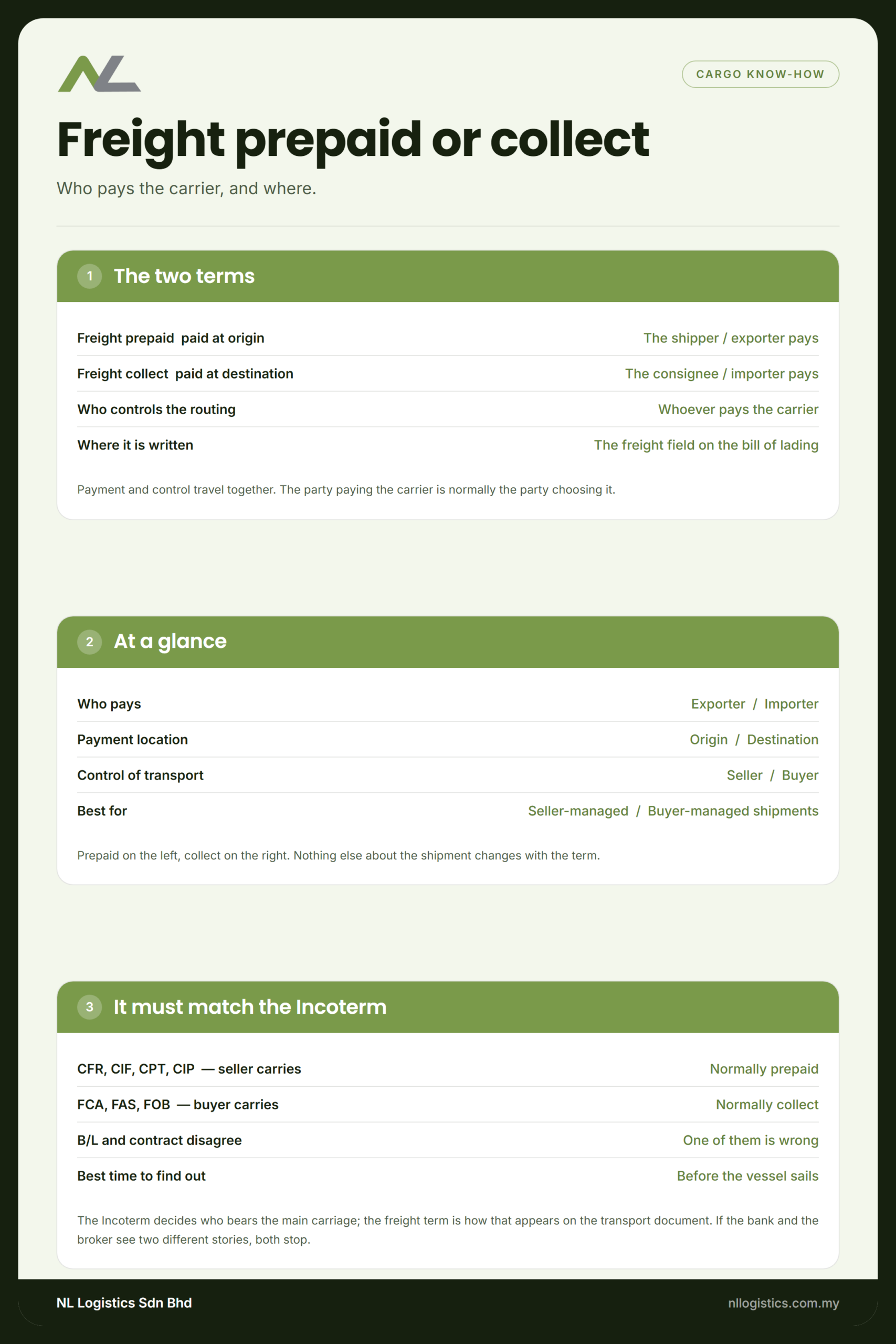

Freight prepaid or collect — the one-page version

The whole guide on a single sheet, sized for WhatsApp and for A4. Ours to give away.

Where this applies

The lines this touches

Where the term is set on the booking and printed on the bill.

Where the documents have to agree with each other, line for line.

Where the carrier collects, at whichever end was agreed.

Not sure which term your contract actually calls for?