Skip to content

Demurrage, detention and storage

Home  —  Demurrage, detention and storage

Three charges that look alike on an invoice and come from three different places.

The charges

The clock starts when the vessel does not

Every container comes with free time — a few days to collect it, and a few more to give the empty back. Miss either window and a charge starts running, per container, per day, until the box moves. On a delayed shipment these are usually the largest unplanned cost, and they are almost always avoidable.

The confusion is that three different charges sound like the same thing. Two are billed by the shipping line and one by the terminal, and which one you are paying depends on exactly where the container is standing.
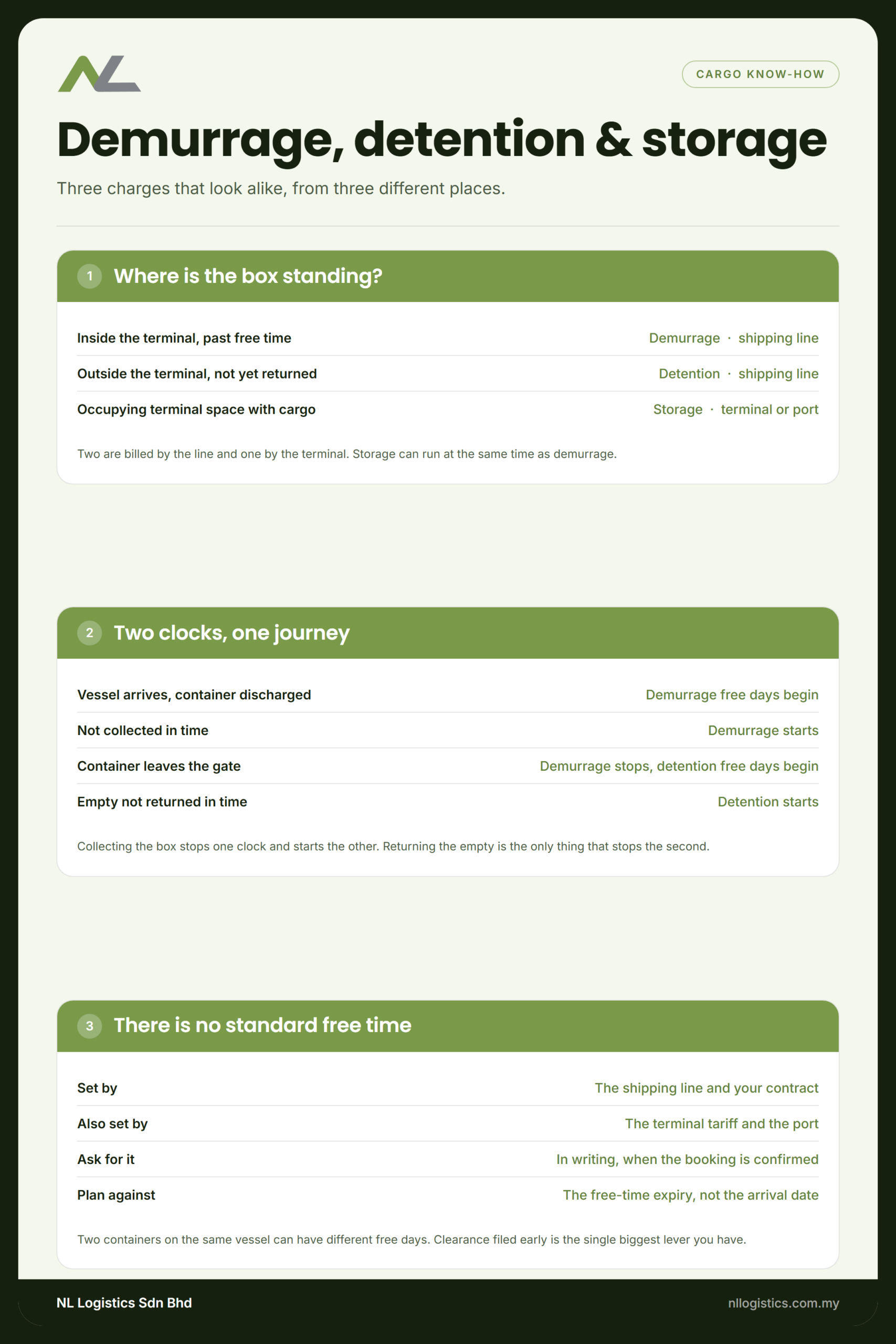

The three charges

Same invoice,

three different landlords

The easiest way to keep them apart is to ask where the box is: inside the terminal, outside it, or taking up terminal space with cargo still in it.

Demurrage

Inside the terminal

Charged by

The shipping line.

For what

The container staying inside the terminal beyond the allowed free time.

Example

The box lands and the line allows five free days. Not collected by day six, demurrage starts.

Best for

Stops the moment the container leaves the terminal gate.

Detention

Outside the terminal

Charged by

The shipping line.

For what

The container being out of the terminal and not returned within the free time.

Example

You collect the box, unload it, and return the empty later than permitted. Detention starts.

Best for

Stops when the empty is accepted back at the depot.

Storage

Terminal space occupied

Charged by

The terminal or port — not the line.

For what

Cargo or containers sitting on terminal premises beyond the free storage period.

Example

Cargo stays in the terminal past the free period the terminal allows. Storage applies.

Best for

A separate tariff, and it can run at the same time as demurrage.

The timeline

Where each clock

starts and stops

One container, one journey, and two separate free-time windows along it.

From vessel to empty return

01

Vessel arrives

The ship berths at the destination port.

02

Discharged

The container is landed into the terminal.

03

Free time runs

The line’s demurrage free days. Collect inside this and there is nothing to pay.

04

Still in terminal

Past the free days and the box is still inside — demurrage starts.

05

Collected

The container leaves the gate. Demurrage stops, detention free time begins.

06

Empty not returned

Past the detention free days with the box still out — detention starts.

Why the box was late in the first place

Eight things that hold a container up

Delays are rarely one factor. Shipping depends on a connected chain of vessels, ports, customs, terminals, equipment, hauliers and paperwork — when one link slows, the whole chain feels it.

Port congestion

Too many vessels and containers, or limited terminal capacity, slowing vessel and yard operations.

Vessel delays

Weather, operational problems, schedule changes, or delays at previous ports affecting arrival times.

Customs holds

Incomplete documentation, inspections, classification issues or regulatory requirements preventing release.

Documentation errors

Incorrect or missing documents delaying customs clearance, terminal release or delivery.

Equipment shortages

A shortage of suitable containers, chassis, trucks or other equipment disrupting the planned movement.

Transshipment delays

A missed vessel connection leaves the container waiting for the next available sailing.

Inland transport problems

Traffic congestion, driver and truck shortages, road restrictions, rail capacity or breakdowns.

Weather and the unforeseen

Storms, heavy rainfall, port closures, accidents and other unexpected events affecting the chain.

Also worth keeping

What a delay actually costs

The daily charge is the visible part. These are the rest of it.

Longer transit time

Every downstream date moves with it

Demurrage, detention and storage

Per container, per day, until the box moves

Inventory shortages

Stock that is on the water is not on the shelf

Missed delivery schedules

Promises made to your own customers, broken

Customer dissatisfaction

The part that does not appear on any invoice

Higher logistics costs

Expedited replacement freight, at short-notice rates

Before you book

There is no standard free time

What decides your free days

The shipping line, the terminal tariff, the port and your contract terms

Free time is not a rule of the port; it is a term of your booking. Two containers landing on the same vessel can have different free days because they were booked with different lines or under different contracts. Ask for the free time in writing when the booking is confirmed, and plan collection against that date rather than against the arrival date.

Demurrage, detention and storage — the one-page version

The whole guide on a single sheet, sized for WhatsApp and for A4. Ours to give away.

Where this applies

The lines this touches

Clearance filed early is the single biggest lever on demurrage.

Haulage booked against the free-time window, not after it.

Somewhere to put the cargo so the box can go back empty.

Facing demurrage on a container that has not moved yet?