Skip to content

Reading a Bill of Lading

Home  —  Reading a Bill of Lading

Which document you are holding, who issued it, and what has to happen before the cargo is released.

The documents

One name, several different documents

A bill of lading is three things at once: a receipt for the cargo, the contract of carriage, and — sometimes — the title to the goods. That last one is why the paperwork matters. Get the release route wrong and a container sits at the destination port, accruing charges, while an original document travels by courier.

Bills are classified three ways, and the three are independent: by the condition the cargo was in, by who may claim it, and by who issued the document. A single shipment has answers to all three.

By cargo condition

What the carrier

wrote down on receipt

This one is decided the moment the cargo is handed over, and it is very hard to change afterwards.

Clean B/L

No remarks

Issued when

The carrier receives the cargo in apparent good condition.

What it says

Nothing — no remarks about damage or defects.

Why it matters

Banks and letters of credit generally require a clean bill.

Best for

The normal case, and the one to aim for.

Claused / Foul B/L

Remarks added

Issued when

The carrier notices damage, shortage or irregularities in the cargo or packaging.

What it says

The defect, in writing — “3 cartons damaged”, “packaging torn”.

Why it matters

It can block payment under a letter of credit and shifts the argument to your insurer.

Best for

Nobody wants one. Pack and check before the carrier does.

By who may claim the cargo

Who the document

lets collect the goods

This decides whether the shipment can change hands while it is still at sea.

Straight B/L

To a named consignee

Consigned to

One named party.

Transferable

Generally not negotiable.

Delivery

To the named consignee, and nobody else.

Best for

Sales already paid for, or shipments between related companies.

Order B/L

To order

Consigned to

“To order” — the party is decided later.

Transferable

Yes, by endorsement.

Delivery

To whoever holds the properly endorsed bill.

Best for

International trade and documentary credit, where a bank sits in the middle.

Bearer B/L

To the holder

Consigned to

Whoever physically holds the document.

Transferable

Highly — simply by handing it over.

Delivery

To the bearer.

Best for

Rare now. Losing the paper means losing the cargo, so it is uncommon in modern shipping.

By who issued it

House and master

are not alternatives — you may have both

On a consolidated shipment the line issues one master bill to the forwarder, and the forwarder issues a house bill to each shipper inside it.

HBL

House bill of lading

Issued by

The freight forwarder or NVOCC.

Issued to

The shipper.

Consignee

The actual consignee, named.

Used for

Delivery and customs clearance at destination.

Covers

One shipper’s cargo. A single shipment can have several HBLs.

Best for

This is the document most exporters actually hold.

MBL

Master bill of lading

Issued by

The shipping line.

Issued to

The freight forwarder or NVOCC.

Consignee

Usually “to order”.

Used for

Control of the shipment between line and forwarder.

Covers

The whole container — one MBL can sit over many HBLs.

Best for

Not used for customs clearance by the shipper.

Getting the cargo released

Three routes,

and two of them are confused constantly

Same cargo, same destination, different release process. The one you choose decides whether a courier is on the critical path.

Original B/L — more time, and a courier involved

01

Original issued

The carrier issues an original bill of lading.

02

Sent onward

The original must physically travel to the destination.

03

Presented

Cargo is released only once the original is presented.

04

Released

The original document has to be there. If it is not, the cargo waits.

Telex release — the original exists, but stays at origin

01

Original issued

An original bill of lading is issued as normal.

02

Surrendered at origin

The shipper surrenders all originals to the carrier at origin.

03

Carrier notifies

The line authorises release at destination without the original.

04

Released

No courier, no original travelling. Faster, and one less thing to lose.

Sea waybill — no original to surrender at all

01

No original issued

There is no negotiable original document in the first place.

02

Named consignee

The cargo is consigned to a named party from the outset.

03

Released on identity

The named consignee takes delivery as per the sea waybill.

04

Released

The simplest and quickest of the three — but the cargo cannot be traded in transit.

Before you book

Telex release and a sea waybill are not the same thing

The difference that costs people money

Telex release surrenders an original. A sea waybill never had one.

They feel the same at the destination counter — no paper to present — but they are different instruments. A telex release still involves a negotiable document that existed and was given up; a sea waybill is not negotiable and cannot be endorsed to a buyer. Before the vessel arrives, ask one question: what release status does the shipping line actually have on record for this shipment?

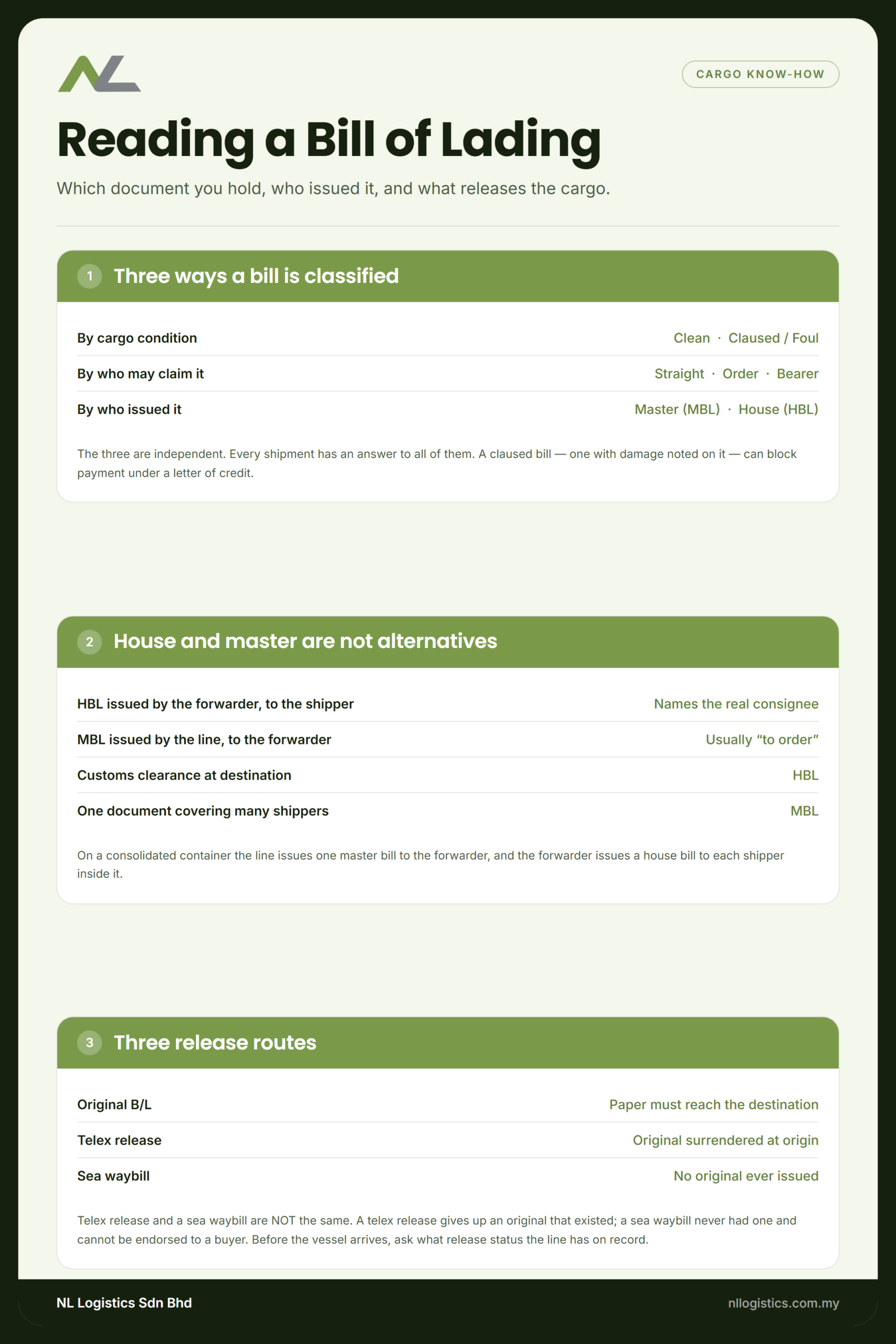
Reading a Bill of Lading — the one-page version

The whole guide on a single sheet, sized for WhatsApp and for A4. Ours to give away.

Where this applies

The lines this touches

Where the house bill is issued and the release route is set.

Where the master bill and the line’s own records sit.

Where the document has to match the declaration, line for line.

Not sure what release status your shipment is on?