Skip to content

Container types and sizes

Home  —  Container types and sizes

Which box your cargo fits, and what it costs you to pick the wrong one.

The equipment

The box is the first price you agree

A container is a fixed volume with a fixed weight limit, and a shipment that misses either one is paying for air or paying for a second box. Cargo that cubes out — fills the space before it reaches the weight limit — wants height. Cargo that weighs out wants a smaller box and a heavier payload allowance.

Four boxes cover almost everything that moves through a Malaysian port. The rest of the range exists for cargo that will not go through a door.

The everyday four

What actually fits,

and what it will carry

External dimensions are the box on the quay. Internal dimensions are what you can load, and they are what matters when you plan a stow.

20GP

20-foot general purpose

External

6.06 × 2.44 × 2.59 m

Internal

5.90 × 2.35 × 2.39 m

Cubic capacity

33.2 m³

Max gross weight

30,480 kg

Pallets

10 standard

Best for

Small shipments, heavy cargo, or when space at the other end is limited.

40GP

40-foot general purpose

External

12.19 × 2.44 × 2.59 m

Internal

12.03 × 2.35 × 2.39 m

Cubic capacity

67.7 m³

Max gross weight

30,480 kg

Pallets

20 standard

Best for

Large shipments, bulky items and general cargo. Twice the volume of a 20GP for nowhere near twice the freight.

40HC

40-foot high cube

External

12.19 × 2.44 × 2.90 m

Internal

12.03 × 2.35 × 2.69 m

Cubic capacity

76.4 m³

Max gross weight

30,480 kg

Pallets

22 standard

Best for

Light but bulky cargo. The extra 30 cm of height is nearly 9 m³ more space at the same payload.

40 Reefer

40-foot refrigerated

External

12.19 × 2.44 × 2.90 m

Internal

11.56 × 2.29 × 2.54 m

Cubic capacity

67.5 m³

Max gross weight

30,480 kg

Pallets

21 standard

Best for

Temperature-sensitive cargo — food, pharmaceuticals, chemicals. The refrigeration unit and insulation take the space.

The rest of the range

For cargo that will not go through a door

Availability and rates for these are booked case by case, not off a standard tariff.

45′ high cube

External 13.72 × 2.44 × 2.90 m. More cubic space again for voluminous, lighter cargo. Not accepted everywhere — check the road permit at both ends.

20′ reefer

External 6.06 × 2.44 × 2.59 m. The same temperature control in a half-length box, for smaller perishable consignments.

Open top

Available in 20′ and 40′, the same width and height as a dry box. The roof comes off so cargo can be craned in from above rather than pushed through the door.

Flat rack

Available in 20′ and 40′ with 8′ end walls and no sides or roof. For heavy, oversized and machinery cargo; the ends collapse for easier loading.

Tank container

Usually a tank inside a 20′ frame — 6.06 × 2.44 × 2.59 m. For liquids, gases and certain bulk products.

Heavy-tested boxes

Some 20′ boxes are plated to 32,500 kg gross rather than 30,480. The plate on the door is the only figure that counts.

Before you book

The figures on the door beat the figures on any chart

Where the numbers come from

Maximum gross weight = whatever the CSC plate on that container says

It depends on the box’s CSC rating, its tare weight, the shipping line, vessel and port restrictions, and the road regulations at both ends. Charts like this one are for planning; the door markings and the carrier’s own specification are for booking. Malaysian road limits, not the container, are often what caps a heavy 20′ load.
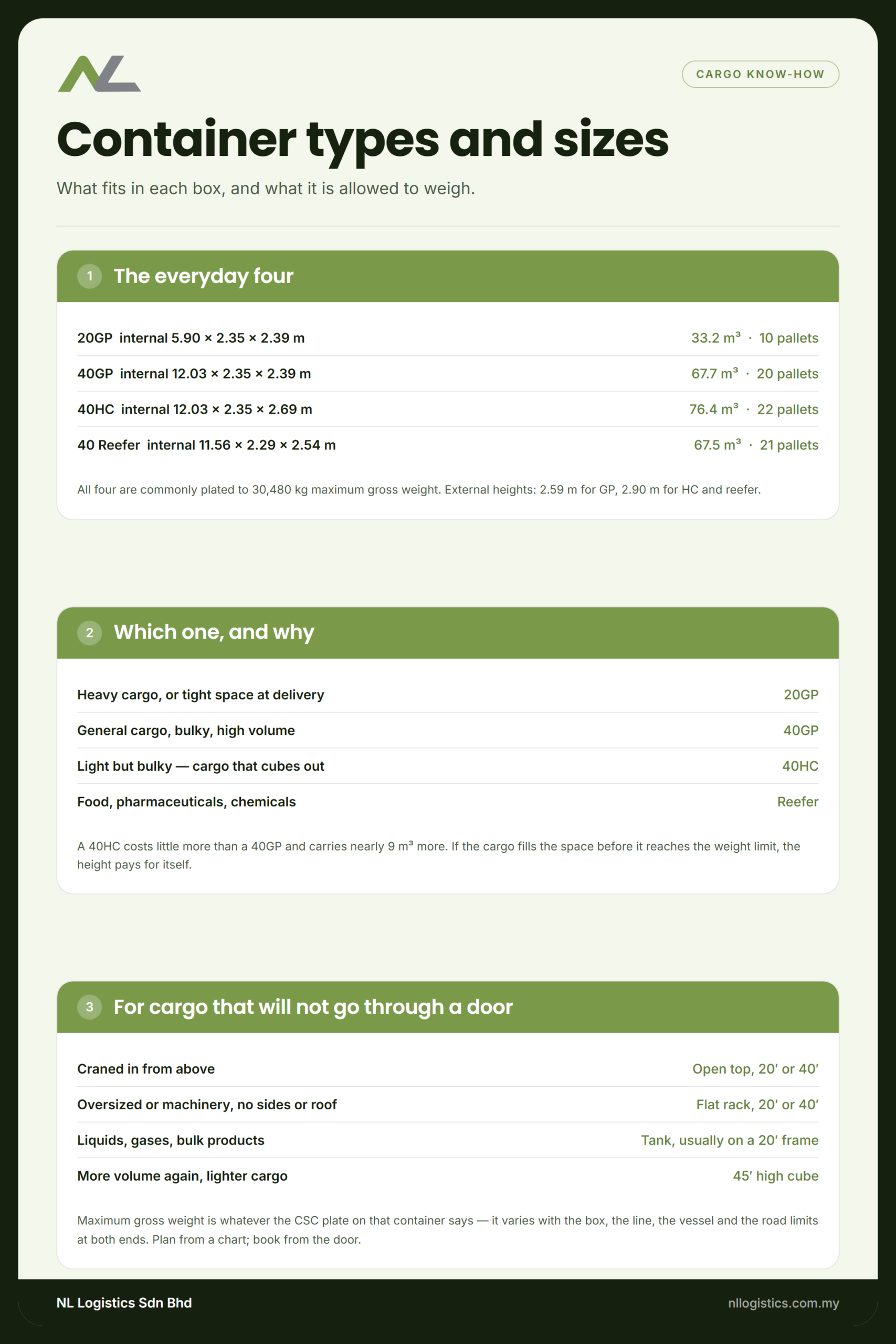

Container types and sizes — the one-page version

The whole guide on a single sheet, sized for WhatsApp and for A4. Ours to give away.

Where this applies

The lines this touches

Where the box is chosen and booked against the cargo.

Where the load is planned, palletised and stuffed.

Where road limits decide what the box may actually leave with.

Not sure which box your cargo should be going in?