Skip to content

CBM and chargeable weight

Home  —  CBM and chargeable weight

Why the weight on the invoice is often not the weight on the scale.

The measurement

Two numbers describe every consignment

One is what the cargo weighs. The other is how much room it takes up. A carrier sells space and it sells payload, and it will charge you on whichever of the two runs out first.

That is the whole idea behind chargeable weight, and it is the single most common surprise on a first invoice. A pallet of insulation panels weighs almost nothing and fills half a container; a pallet of tiles does the opposite. Priced on weight alone, one of those two is being carried for free.

Step one

CBM — the space

the cargo occupies

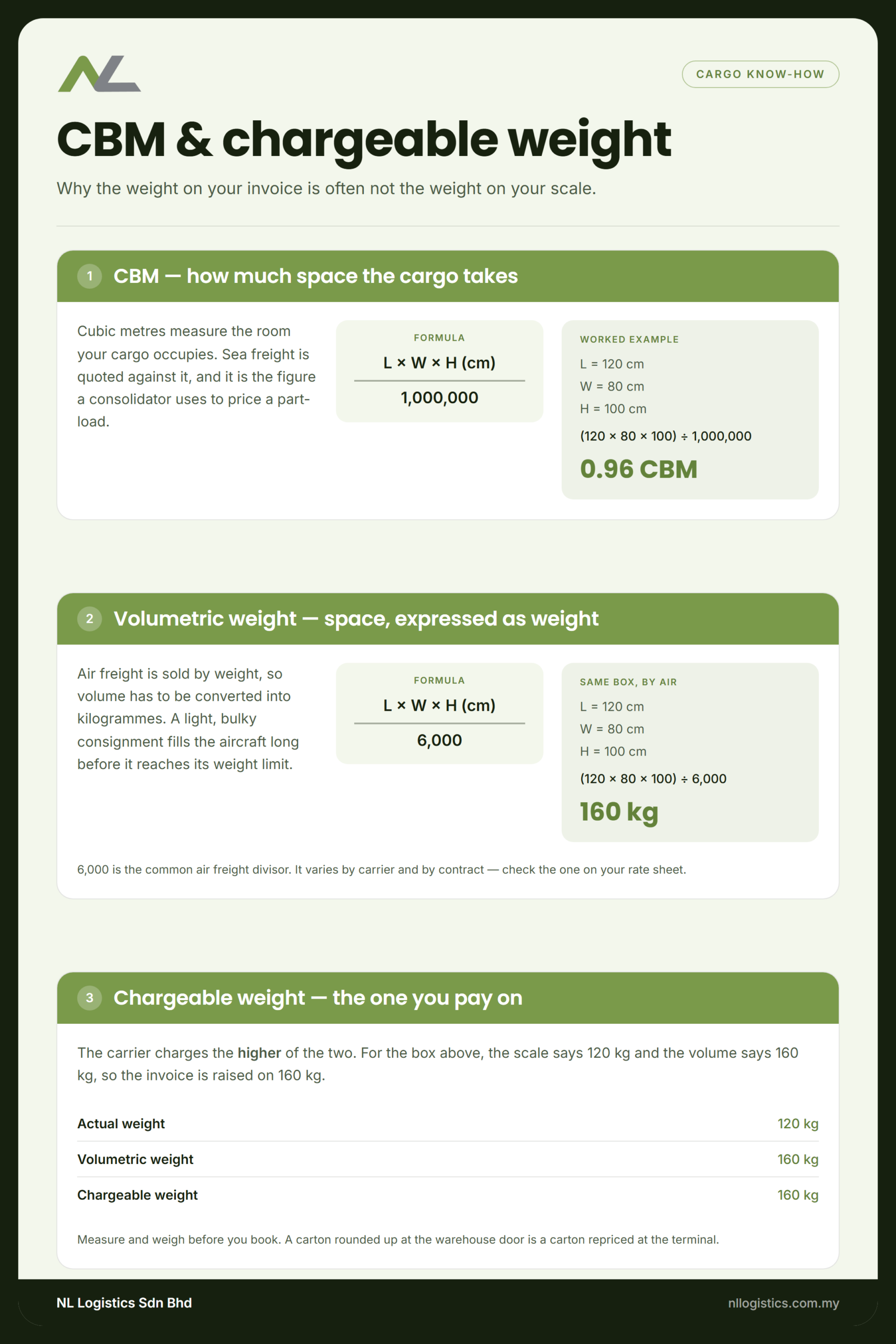
Sea freight is quoted against cubic metres, and it is the figure a consolidator prices a part-load on.

Cubic metres

L × W × H (cm)

1,000,000

Measure the outside of the packed carton, not the goods inside it. Pallet feet and shrink wrap are chargeable space.

Worked example

Length  120 cm
Width    80 cm
Height  100 cm

(120 × 80 × 100) ÷ 1,000,000

0.96 CBM
Step two

Volumetric weight —

the same space, as kilogrammes

Air freight is sold by weight, so volume has to be turned into a weight before it can be priced.

Volumetric weight (air)

L × W × H (cm)

6,000

6,000 is the common air freight divisor. It varies by carrier and by contract — read the one on your rate sheet before you budget.

The same box, by air

Length  120 cm
Width    80 cm
Height  100 cm

(120 × 80 × 100) ÷ 6,000

160 kg
Step three

Chargeable weight —

the one you actually pay

The carrier takes the higher of the two figures. Nothing else about the shipment changes it.

The rule

Chargeable weight = the higher of actual weight and volumetric weight

For our box: the scale says 120 kg, the volume says 160 kg, so the invoice is raised on 160 kg — a third more than the scale suggested.

Which figure wins

Actual weight    120 kg
Volumetric      160 kg

The higher of the two is charged.

160 kg
Also worth keeping

The rest of the arithmetic

The figures a forwarding desk works out a dozen times a day, in the form they are actually used.

Total CBM for a consignment

CBM per carton × number of cartons

Container utilisation

Total CBM

Container CBM

Multiply by 100 for a percentage. Under about 70% and a smaller box, or a part-load, is usually cheaper.

Freight cost per CBM

Total freight

Total CBM

Freight cost per kg

Total freight

Total gross weight

Pallet count

Total CBM

CBM per pallet

Gross weight

Net weight + tare weight

Net is the goods, tare is the packing, pallet and container. Added, not divided — a widely-shared chart gets this one wrong.

TEU

A 20′ box is 1 TEU  ·  a 40′ box is 2 TEU

Sea transit time

Distance (nautical miles)

Average speed (knots)

A knot is one nautical mile per hour, so this gives HOURS. Divide by 24 for days, then add port time at both ends.

CBM and chargeable weight — the one-page version

The whole guide on a single sheet, sized for WhatsApp and for A4. Ours to give away.

Where this applies

The lines this touches

Where the chargeable weight is agreed and the booking is made.

Where cartons are measured, palletised and the real CBM appears.

Where volume decides how many trucks the job needs.

Not sure which figure your quotation was priced on?